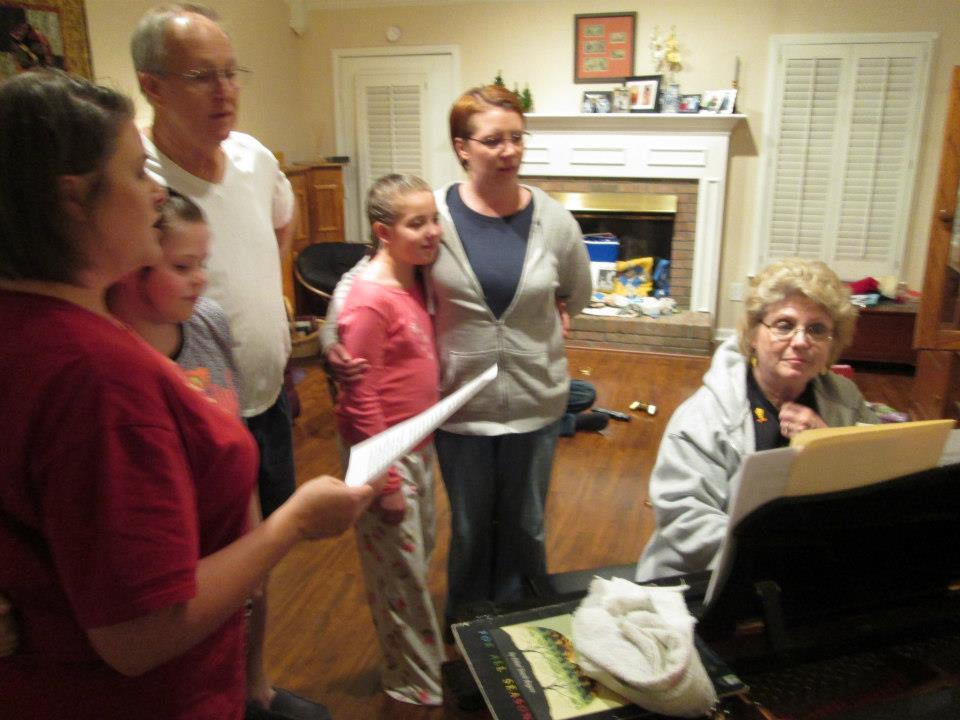
Interview w/Dad (December 14, 2011)

A few years ago, as part of my Masters work, I interviewed my Dad, David. Forgive me for using this space for personal nostalgia, but since that time, my Dad has been diagnosed with Alzheimer’s and we have lost much of him. I treasure the words and advice he gave to me that day in this interview. I am posting it here as an encouragement to others that I, too, can look back on in the future.


As a minister and son, I have always looked at the example my father set in ministry, especially as a leader. Growing up, others in our congregation have always characterized him as passionate and caring. While these characteristics did not always play out in the best light at home, as a leader, my father, David, is an excellent example of a pastor and mentor.  

Dad attended the University of Mobile as a History major. He never intended to become a full-time minister, although he served part-time while getting his degree. This led to a call to ministry. In 1995, David felt the call to leave his position as Minister of Music at Hillwood Baptist Church in Huntsville to plant a church in an obscure section of Huntsville. He met with his pastor and staff and informed them of this idea, seeking prayer and council. The summer of 1996, Dad left Hillwood to plant Farley Community Church. Many thought this was an odd decision and location, as Farley Community was not the most desirable place to serve. However, through the past 15 years, God has shown His plan for Dad and Farley Community Church by changing many lives and families.

For the sake of the interview, I divided the 16 questions up into 3 categories- ministry development, church and staff relations and the theology of ministry. The first category, ministry development deals with the personal and professional development of Dad’s ministry. The second category, church and staff relations, deals with the roles, personalities, and delegation that comes with ministry. The third category, the theology of ministry, deals with David’s views on ministry and serving in a church.


Ministry Development

1. Who were leadership examples for you?

I had many leadership models and some were excellent.  Quite possibly I learned as much from the poor examples as the good examples. My Dad, JR, was the biggest influence in my life. Not only was he a godly father, he was also the Minister of Music and Education in all the churches I attended as I was growing up. I watched him work with choirs and deal with the disappointments that came as members of the church failed to carry out the tasks they had accepted to do. I watched as he encouraged the youth and young adults, and I was influenced heavily by the respect he showed the senior adults and the elected leadership in the church, even when they were in disagreement and even when they were disagreeable. Other examples that heavily influenced me were:  Mr. Westbrook, my band teacher, who, although I was a lousy player, treated me with respect and gave me proper discipline when it was needed; Rev. Al Finch who was my pastor during high school; and (second only to my Father) my Mother who encouraged me to read.

2. How did you first realize you were a leader?

At the age of seventeen, I was called as the Interim Minister of Music at the Riverside Baptist Church in Mobile, Alabama, which, at the time, averaged over three hundred in attendance. I learned how to lead a choir when over half of those choir members were three times my age. Leadership of the choir was more than selecting music and working to make it suitable for a worship service. I had to learn how to deal with egos, opinions, personalities, and I found out that I liked doing it.

3. Characterize your leadership style in three terms.

Consensus (building unity); flexibility; consistency

4. How has your vision of ministry changed over the course of your ministry?

For the first thirty years in the local church, I was a staff member who served as support for my Pastor. I learned how to be positive about a direction and how to emphasize strong points even when I did not totally agree with that direction or method. Every Pastor and staff member with whom I’ve had the privilege to work has contributed either positively or negatively to how I now lead as the Senior Pastor. I don’t really see a tremendous change in how I see ministry now versus how I had thirty years ago. I have always been a “people person” seeking to develop relationships with the lost in order to lead them to Christ and developing relationships with those who are saved to lead them to spiritual maturity.


            Dad was heavily influenced by members of his family and church in developing of his own personal ministry. Not so many are blessed to be raised in a godly home and in church like Dad was (and I was).  This was instrumental in the development of his personal talents, leadership style and ministry aspirations. 

            Mid-career, Dad chose to change titles and positions from Minister of Education to Pastor/Church Planter. With this transition came new tasks and responsibilities. However, his past ministry, as a part of a ministry team, became useful when required to lead others in vision and ministry. 


Church and Staff Relations

1. As a leader, how do you deal with conflict in your congregation?

I will not compromise on principles or on Biblical truth, but I don’t feel that my opinion is necessarily the best on every issue, nor do I feel I should get my way every time. If someone is upset with a situation or me, I will sit down with him or her, hear him or her out, seeking reconciliation and healing. If an issue is divisive, then I will take a demonstrative stand without concern for how that stand will affect me. I am more concerned with healing, reconciliation, and redemption than with how I am affected. If it does not compromise principles or Biblical truth or does not damage the ongoing ministries of the church, I seek common ground.

2. What role does delegation of responsibility play in your ministry?

We have clearly defined roles, in writing, for each one of our ministerial and administrative staff. When issues arrive that are not covered in these written role descriptions, we meet together for clarification. We have a chart that clearly shows who is responsible to whom. Our church is staff-led and committee-driven with ultimate authority resting with the congregation in areas of disagreement.

3. How do you instill your vision for ministry in your staff?

This is a weakness, at least in the implementation of the process of accountability. I am highly motivated, and I do become frustrated when individual staff members do not share my passion, whether that be to win the lost, minister to the needy, or disciple Christians. I’m not much on setting numerical goals, but I do want my staff to be passionate about their calling.

4. How do you effectively train your staff to lead?

Again, this is an area of great weakness for me. I seek to present a good example of stewardship of time, but I have never established any ongoing training for our staff. This probably leads to a rebellion against accountability that plagues us.

5. How do you relate to other leaders and ministers in your community?

I do not have much contact with any ministers in this Association, nor do I spend a great effort in cultivating relationships outside this church. Instead I maintain contact with those outside our church whom I feel need salvation, or those being cultivated for leadership within the local body. I have participated actively with an interdenominational Concert of Prayer that meets bi-monthly in our city. That gathering has been encouraging, and praying together with pastors across denominational lines has strengthened me immensely.


            Through these answers, we can see that Dad is passionate about his calling and ministry. However, he has a weakness in passing that vision and passion on to those on his staff. It is important for every ministry team member to know their role and responsibilities, but also to understand why and how these roles were created and are to be fulfilled. Dad admitting this is an area of struggle is interesting to me, as I am fully aware of what his vision for ministry is. He has instilled that vision in me and I am working in my own congregation and family with the same vision, to be out in the community, loving the lost and hurting of the world.

            It is also important for Dad, as with other ministry team members and leaders, to be held accountable. Dad admitted that this was an area that “plagued” his ministry. Without accountability, a ministry cannot be maintained through trust and good relations. This is an area that, through my own personal studying, I have been working on with my own ministry team, personal and professional accountability. Not out of fear of moral or otherwise failure, but out of personal and professional growth. In this, my staff and myself, stay above reproach. 


The Theology of Ministry

1. As a leader, how do you determine God’s will for your ministry?

I assume we all get caught up in the day-to-day grind and often lose sight of direction or goals. We can all become bogged down and sacrifice what needs to be done for what must be done. Sermons must be written, Bible studies prepared, newsletters and mail outs, ministry needs and witnessing to the lost. Soon the task is overwhelming. There are some tasks that must be done: crises counseling, committee meetings, and worship preparations, family time. Soon the personal time for prayer, personal study, and exercise suffers. How all this fits together must be in keeping with God’s will for the ministry to which He has called me. Is it God’s will that I met with the three young adult men for fellowship and devotion early this morning when I could have been spending that time in prayer and study? What about lunch today with the two ninth grade students who are lost? Will that allow me the time necessary for follow-up with the unmarried couple living together that was here for Bible study last week? Sometimes it is an insurmountable task to differentiate between what is God’s will for each day. Directing a staff and a church to accomplish His will is so much a greater task.

2. What role does holiness play in your leadership style?

My personal Bible study for the last two weeks has been from James 4:1-10. Pursuing holiness is an everyday growing relationship: putting off that which encumbers and putting on that which frees us. Within the confines of a crowded schedule, it is a necessary work to “Draw near to God. . .” I cannot function without a constant infilling of His Spirit. This is also a good place to mention the necessity of “rest” (physical and spiritual).

3. What role does servant hood play in your leadership style?

Does my staff see me as the leader who directs from an unapproachable office or do I experience ministry with them in visits to the hospitals and retirement homes, benevolence ministries, the seeking of the lost? If I am not a servant, how can I expect them to be servants?

4. What are some of the qualities of an effective leader?

An effective leader knows who he/she is and where they are going. An effective leader demands more of themselves than their co-workers. An effective Christian leader cares first for the One we truly serve and then serves others in humility. An effective leader leads rather than pushes, encourages rather than condemns, knows where they are going and clearly communicates that to those whom he is called to lead.

5. How do you balance ministry and your personal life?

Again, this is an area of personal struggle. As much as possible, I’ve sought to intertwine the two.  My children have visited hospitals, nursing homes, senior shut-ins, and prospects with me. We worked on music together, and they helped me decide which music would work best with which choir or ensemble. As a family, we sang through cantatas before the choir saw them. Today, if I need ministerial advice, I am most likely to call my son or one of my sons-in-law who are ministers. One daughter keeps me informed on the books I need to be reading to be current with ministry styles. I do not split the sacred from the secular with my family. All of life, for us, is sacred and we share of what God is doing in and through each of us.

6. What advice would you give a young minister learning to lead?

Never expect others to do what you are unwilling to do yourself! Set goals and chart progress, not for your church’s growth but in your personal ministerial life. Who are you helping to mature in the faith? Who are you cultivating a relationship with in order to share the Gospel? Who will you share the Gospel with today, this week, this month? When was the last time you shared the Gospel, one on one, with someone who was lost and they came to know Christ as Savior OUTSIDE THE PHYSICAL WALLS OF THE CHURCH? Love your staff and be their servant! Love your people and be their servant. Never expect from your staff or congregation the work, respect, love. . .that you do not give them.

7. Where do you see your ministry in 5 years?

I pray God will open the door for me to work in a small rural church where I can be one-on-one with my people. I love my church and am blessed to be here, but I don’t want to burden this church with a slowing, ineffective administrator. The ministries here are explosive; the staff size is increasing; and the opportunities are overwhelming. This church deserves a more effective, more energetic pastor, and I need a place more in keeping with my abilities and my energy level.


            Balance is important in the life of everyone, but especially leaders in ministry.   Like Dad said, the difference between personal study time and ministry is often indiscernible. However, time with family and physical and spiritual rest are required for a vibrant and Spirit-led ministry. 

            Dad keeps with our texts in the importance he places on personal holiness and servanthood. Making time for personal devotion and prayer is vital to the maintenance of personal holiness. As Dad said, “pursuing holiness is an everyday growing relationship.”  We cannot expect to grow a life of holiness without taking the time to spend in personal devotion and prayer. 

            If I have noticed one thing about watching my Dad minister, it is that he is a servant. Every Sunday, you can find him making coffee, setting up chairs, vacuuming, etc. He sets an example for his staff (and family) in service, and thereby inspiring them to do the same. Dad leaves us parting words about servant hood and effectiveness. Spending time outside of the church with the lost and hurting of the community is vital to the success of any ministry. Time with the lonely, outcast and downtrodden will provide the leader the means to share the gospel, cultivate relationships and set example for others on their staff and in their congregation. This is what ministry is all about, loving the lost and hurting of the world.

Careful Planning

We all have our own preferences. For instance, I prefer BBQ sauce over Ranch on my chicken. I prefer the mountains to the beach. I prefer Pepsi Zero to Coke Zero, and that’s a hill I will die on.

I also have my own personal preferences in worship. I prefer a good blend of the old classics and new hits. I prefer low lighting as it helps me to focus. I prefer live instruments over canned tracks. And, I have plenty more.

However, seldom do my preferences matters when it comes to planning worship. When planning a service, I often have to fight the urge to impose my preferences on to the worship service.

Robbie Castleman writes, “Now, worship planners and church leaders might verbalize a dependence on God’s Spirit to lead, guide, move and bless the congregation in a service of worship. But if a believer’s experience or congregational need shapes the service, the actual walk doesn’t give evidence for such talk.”[1]

I meet with a group of area Worship Leaders every Thursday morning at 8:00 AM. It really is a special time for me, personally. We all do life together, and share with each other our joys and our burdens of worship ministry. I recall one of the discussions we had discussing the flow of the worship service, particularly the planning of worship. It goes without saying that each of our desires is for the Lord to have His way in the worship service. Although we are responsible for the our congregations each and every Sunday, it is God who is the Lead Worshipper. We ultimately want to be discerning in listening to Him as we carefully plan each worship service. This is not easy. Sometimes that voice we long for and crave goes silent. What do we do then? What do we do when the direction and calling grows stale?

Oftentimes, when I feel stuck or stale, I tend to fall back in to the same patterns of behavior. I often find myself looking back over previous worship services, hoping for a spark of inspiration. I also spend time looking through the Scripture that’s being spoken on that particular Sunday…if I am fortunate enough to receive it before Saturday evening. But, for some of us, we rely often on our own agenda or our personal preferences to mold and shape the worship service. It’s easy to fall back onto our old standards or favorites. Worship Leader… THIS IS DANGEROUS!

Francis Chan famously shared an interaction he had with a church goer after a service one day where the church goer criticized the worship saying, “I didn’t really enjoy worship today.” To which Chan responded, “That’s OK. We weren’t worshipping you.”

Our preferences do not hold any weight on the worship service: It’s God’s service, therefore it’s God’s plan. And sometimes our careful planning can be interrupted by the Holy Spirit. I grown to appreciate and love those interruptions. It makes for a much better worship service.


[1] Robbie Castleman, Story-Shaped Worship: Following Patterns from the Bible and History (Downers Grove, Illinois: InterVarsity Press, 2013), 194.

The Plight of Co-vocational Ministry – Part 2

Let me expand on my previous post a little further:

I believe that one of the most significant issues today impacting worship services across the Southern Baptist Convention (SBC) is the lack of support and training offered to co-vocational or part-time worship leadership. Due to the steady decline in financial giving and the plateaued growth in many congregations, this phenomenon will most likely only continue to grow as congregations are having to cut costs across the board. This is especially true of mid-size churches that can afford a full-time Senior Pastor but cannot afford full-time secondary staff, such as the Worship Pastor. Although this phenomenon is a reality for churches of all sizes.  LaRochelle reports in Part-Time Pastor, Full-Time Church, “The reality is that congregations generally have limited resources and, because of the limitations within which they have to live, are forced to make decisions about how best to formulate a staff so as to meet the real needs of the local church.”

My own research suggests that many part-time or co-vocational Worship Pastors feel overlooked or underserved by the SBC. There is an attitude among many in the Christian post-secondary institutions (especially the institutions supported by the SBC) that co-vocational employment is somehow less than. Even when I went through seminary and into my doctorate, it was expected that we would all land full-time positions as soon as we graduated seminary. The reality is very different for many ministers. 

The phenomenon of co-vocational church leadership needs to be reassessed by many in leadership, both in the SBC and in parachurch organizations. Christopher Hagen writes, “Forecasts of total membership, amount of giving, worship attendance, and so on are that of decline for mainline Protestant churches.” This decline is not expected to change any time soon, so the church must adapt. Rudy Gray writes, “Even though accurate data is unavailable, it is still obvious to many Southern Baptist leaders that co-vocational ministry makes up 50 percent or more of our total profile — and it is growing.” The Church, as a whole, needs to reassess how we treat and support co-vocational Worship Pastors.

Unfortunately, through my research I have discovered that many co-vocational or part-time worship pastors feel alone and abandoned by the denomination that is known by its cooperation to support so many. The few part-time worship leaders that are fortunate to be educated or trained in their calling are often outnumbered by the nurses, teachers, mechanics, college students and retirees that are called upon by their congregation to help out on Sundays in the worship team. Many of these congregations cannot afford to send these servants back to be trained in worship leadership. There are very few affordable post-secondary programs available to them. Even the music conferences or training events often require these co-vocational servants to miss their “day job” to attend. 

So, what is the answer? Mentoring. There are so many larger congregations in the Southern Baptist Convention that employ trained and educated worship leaders. We need to stop viewing other congregations as competition. We need to understand that cooperation is the key to the gospel. Those that are fortunate enough to have the training and education need to share their resources. This could be easily facilitated by an organized, denominationally-driven mentor program. 

There are precedents set by other denominations that foster the building of mentoring relationships within and outside the denominational lines. The Leadership Program for Musicians is one such program established by the Episcopal Church’s General Convention. Rideout explains in the American Organist,

The LPM program was designed for those who (1) had not yet had the opportunity to develop their musical skills through long-term education or continuing education, (2) might have studied music in a college environment but did not study how to plan and lead worship or how to select hymns and service music, (3) were members of other denominations yet served in Episcopal congregations and needed to know more specific information, (4) were young musicians with potential for church-music leadership, and (5) desired positive

professional relationships with other musicians and clergy.

Building such a program within the Southern Baptist Convention would be an easy means of providing many underserved worship leaders with the cost-effective and timely tools they need to be better prepared for their ministry. However, as mentioned at the beginning of this dissertation, that idea is simply not on the radar of the Southern Baptist Convention, other denominations have already put mentoring strategies into place. In order to see a lasting monumental change, the denomination must make mentoring and training the part-time worship leader a priority.


Sources and Further Reading

Hagen, Christopher E. “The Low-Cost Church.” The Clergy Journal 76, no. 2 (Nov, 1999): 17, http://ezproxy.liberty.edu/login?url=https://search-proquest-com.ezproxy.liberty.edu/docview/230525947?accountid=12085.

Rudy Gray, “Is Bivocational Ministry the New Normal?,” The Baptist Courier (November 6,2016), https://baptistcourier.com/2016/11/bivocational-ministry-new-normal/.

Rideout, “Value Added: The Leadership Program for Musicians,” 42.

Relationships Matter

Relationships are one of the most critical parts of the human existence, both our relationship with God and with others. Relationships can make or break you worship.

Relationships matter.

For the Worship Leader, building and developing lasting relationships is essential for any future success in ministry. Relationships are the meter which determines if your ministry fails or flourishes. 1 Corinthians 1:10 tells us, “I appeal to you, brothers, by the name of our Lord Jesus Christ, that all of you agree, and that there be no divisions among you, but that you be united in the same mind and the same judgment.”  Solid biblical relationships are even more crucial as a Church Leader. Being a relational leader takes hard work, but the results are so worth it.   

Unity is key to relationships of any type, especially within a multigenerational church.  Bob Kauflin says, “The scattered church throughout the week is still the church.  But gathering together is a physical demonstration and reminder of our distinctness from the world and our unity in the gospel.  We show that we’ve been drawn apart from the world and drawn together to God.”[1] 

Worship is primarily a relationship. When we worship, we commune with God. This is our time spent in His presence, whether we worship corporately or privately. When we enter His presence, we bring Him our cares and concerns, we listen for His voice and we praise Him. As worship leaders, we are relationship leaders. We lead others to the throne of grace. However, this is not where our responsibility with our relationships end.

In religion, the primary indicator of a meaningful relationship is discipleship. Jesus told us in one of His last directives to go and make disciples.[2] Today’s generation of church-goers has far more outside influences than any of the generations that came before. It is because of this that the church, needs to redirect its focus on building the body of Christ as a whole and complete unit. 

One church. One mission. One calling.

More and more churches are emphasizing small groups. Small groups allow people to open up their lives to each other in a more intimate setting than a larger corporate service. My wife and I are blessed with an incredible small group. We call ourselves the “Young Adults,” but we’re not so young anymore. But, let me tell you, when I know I have a group of likeminded believers in my corner that love and support me, that is worship.

As a worship leader, I try to be as involved with as many people as I can.  I want to get to know them, their family, and how I can better serve them. Blackaby says, “Those in prominent positions must always remember that without followers, they are not leaders.”[3]  At the church we serve, my wife and I are involved in one of the healthiest small groups I’ve ever encountered. We are literally “doing life” together. We know we are being prayed for. We can call any of these men and women at a moment’s notice. We are literally fighting our spiritual battles with some of the finest soldiers in the Lord’s army. What a blessing!

Where our strengths lie is usually where we are most successful.  I consider myself a good worship planner, and I can execute a worship service well.  Beyond the task of planning and leading worship services, I also invest in relationships with other people, inside and outside our small group.  I do this by meeting with individuals for lunch or just having a cup of coffee together.  Through this intentionally relational time I learn more about how each individual can contribute to the mission of the church, whether in worship or not.  I learn how the church can serve them. I learn their stories and what God is doing in their lives. Not only am I making a commitment to getting to know the person, but I am also providing them an opportunity to serve and be served.

Developing a plan for building and maintaining relationships is key.  As with any career, relationships are an essential part of the work.  However, there are elements of these relationships that can be difficult to maintain or even troublesome for even the most experienced worship leaders.  Navigating relationships through a biblical plan established early in your career can only serve to protect your ministry and family.  No matter what relationship you may encounter, you must approach it with the love and grace of Jesus Christ.  In his book The Pastor’s Handbook John Bisagno says, “The shepherd is always in front of the sheep, and he is out there alone.  He is the leader and enjoys the privilege of leadership.  But he is always the first to lay down his life for his sheep, to fight and even die in their defense.”[4]  As the Worship Leader, you must be willing to go beyond the normality of leading worship, you must invest in the lives of others.

            Relationships are important . . . really important.  For some, building lasting relationships with others will come easy, but for others it will take work.  Nevertheless, each of us should follow the example Jesus set before us.  “This is my commandment, that you love one another, just as I have loved you.  Greater love has no one than this, that one lay down his life for his friends.”[5]  Jesus built lasting relationships with His disciples, but more importantly He demonstrated a relational lifestyle with those whom He encountered throughout His ministry. He intentionally sought out those relationships. If we are to make a greater impact in our personal ministry for the cause of Jesus Christ, we have to invest in relationships that matter.


[1] Bob Kauflin, True Worshipers: Seeking What Matters to God (Wheaton, Illinois: Crossway, 2015), 77.

[2] Matthew 28:19-20.

[3] Henry T. Blackaby and Richard Blackaby, Spiritual Leadership: Moving People On to God’s Agenda (Nashville, Tenn.: Broadman & Holman Publishers, 2001), 218.

[4] John R. Bisagno, Pastor’s Handbook, [rev.]. ed. (Nashville, Tenn.: B & H Books, 2011), 97.

[5] John 15:12-13 NASB

The Issue of Song Suggestions

Some in my congregation enjoy coming to me with songs that they want to suggest for our corporate worship services. The songs they suggest may be new songs they’ve found on the radio, songs they’ve discovered in their private worship time, or timeless favorites from their past. Each time one of these interactions takes places, I am left in awe of those who choose to take an interest in worship planning.

Discussing worship with each of them is truly one of the many joys of my calling. I love hearing what God is using to move and change those who are seeking Him. The only setback to these encounters is the lack of available space in each worship set to plug in their requests. I wish I could utilize each song suggested to me, but, unfortunately, time does not allow for that.

Worship leaders are one of the top theologians of their congregation. The messages delivered in song can encourage or hinder the personal theologies of hundreds each week. What a huge responsibility! As worship leaders, we will one day be held accountable for the messages we present in each worship set. What are your songs telling your congregation? Are they lifting up the King of Kings or merely sending out a sweet, but meaningless, positive message?

I choose to utilize the BEST POSSIBLE songs each time I step on stage, that means they must sing of King Jesus and His love for us.

A little background for those that are less familiar, a lot of thought and prayer goes into selecting songs for a corporate worship set. Many different attributes of each song are considered when organizing a corporate worship service, including: theme, key signatures, flow, personnel available, etc. More than that, each song must hold up to the standards set in Scripture. Above all, if the song is not biblical, I will not utilize it in worship. Period.

While there are thousands of songs that fit the above criteria, I can further narrow those down to the songs that are the best fit for our worship context. Those will include songs that are vertical in their worship (their main subject is God and not man) and those that fit the theme for our specific Bible passage for the day.

On the contrary, many songs fit the above criteria, but not every song translates well to the corporate worship setting. For instance, take “You Will Be Found” by Cory Asbury & Natalie Grant. I saw “Dear Even Hansen.” It’s a great story. The song is powerful in the context of a secular musical. It’s uplifting and positive…it also does not mention the name of Jesus. Or, on the other end of the spectrum, take “In the Garden” by C. Austin Miles. It’s a beautiful, timeless song. However, it speaks to one’s individual walk with God. With lyrics like, “I come to the garden alone,” or “None other can ever know,” it’s hard to integrate that into a corporate message. As a worship leader, it’s my job to utilize the BEST songs for each individual worship service context. It’s not a responsibility I take lightly.

Why do I write all of this? My point is, KEEP IT UP! Please share with your worship leader what God is revealing to you through a particular song. Don’t be discouraged when they don’t include a particular song that you suggest. They are up against pressures and standards that many will never understand. Your worship pastor genuinely wants to know how God is working through you. I know I do.


Sources and Further Reading

The Berean Test-www.thebereantest.com

http://www.churchleaders.com/worship/worship-articles/304410-church-needs-theologically-minded-worship-leaders.html

http://www.thegospelcoalition.org/article/hey-worship-leader-are-you-a-theological-lightweight/

thebaptistpaper.org/amid-music-minister-shortage-training-shifts-to-emphasis-on-theology/

The Plight of Co-Vocational Ministry – Part 1

A few years ago, my wife and I made the tough decision to leave an unhealthy church situation. I was unhealthy. Church hurt is very real (much more coming on that in a later post). But, needless to say, my family and I left our church battered and bruised. I decided then and there that I was done with ministry. If God wanted me to serve Him again, He would have to move a mountain… or two.

Like the old saying goes, “church would be great if it weren’t for all the people.” For the record, I am the people.

After my family and I left that church, I took a sabbatical and worked at a Christian bookstore for a few months. Even in all of my hurt, God gave me an amazing gift… He surrounded me with some of the most amazing men and women of God, all of which were co-vocational ministers (aka bi-vocational ministers). During this time, He opened my eyes to the plight of co-vocational ministers, paid or unpaid. This became my passion and purpose. Finally, He used these amazing men and women to do something miraculous, He healed my heart and restored my call to Worship Ministry. My sabbatical only lasted about a year, but that was enough. I knew I had to support these men and women in whatever way I could.

A little backstory, I am a 5th generation Music Minister/Worship Pastor/Song Leader. Whatever you want to call it, the men in my family have been leading it for more than 100 years. There are many, many things I don’t know, but I know Church Music. I grew up on the old hymns, singing Southern Gospel with my Dad, uncles, and sisters with my Mom on the piano. I have three post-secondary degrees in Church Music. I can’t do much in the “real world,” but I know Church Music. I have been incredibly blessed to have been as exposed and trained as I have been. It’s not a gift that I take lightly, as I know many others have accepted a call to Worship Ministry without the training and resources that I have been blessed with. So when it came time to work on my doctoral dissertation, I knew what I needed to do. God had given me a passion for the plight of the co-vocational Worship Pastor.

Many of the men I grew to know during that brief period of secular work had surrendered a call to the ministry without the benefit of a theological education, or even church resources to receive any education or training in their area of ministry. The few co-vocational ministers that have the benefit of a seminary degree often graduated from seminary with the understanding that they would always be employed full-time, leaving them unable to properly provide for their family with a marketable skill when God calls them to a co-vocational role. Even our post-secondary institutions have failed to provide much training in the way of an affordable certificate program for anyone except a Senior Pastor. You would be hard-pressed to find any educational resources for the co-vocational minister called in any other area of ministry other than to shepherd a church.

I serve in a SBC church. Theologically, I align with the Baptist Faith and Message. I love our emphasis on cooperation in missional strategies. I appreciate our heart for Disaster Relief, Right to Life causes and the inerrancy of Scripture. Where I feel the Convention has failed is the support of co-vocational ministers. Sure, there are a lot of resources (still not nearly enough) available to support the co-vocational Senior Pastor, but virtually none if you are a co-vocational Worship Pastor, Youth Pastor, Children’s Pastor, etc. Bickers states, “Despite being told by various denominational leaders that their numbers of bi-vocational ministers were growing and are expected to keep growing, I could find no denomination with a staff person specifically designated to work with bi-vocational ministers and their churches.” (p. 20) I can confirm through my own interviews conducted with convention officials, no denominational role exists solely for the support and encouragement of the co-vocational pastor.

If you are looking for support for the Senior Pastor or “ministers” in general, your best bet would be to look to the individual state conventions. Many states have allocated resources and personnel to support the co-vocational minister, although none are allocated to the specific needs of the Worship Pastor, such as musical knowledge, theory, song selection, worship team training, etc. Our best bet is to come alongside our brothers and sisters through personal mentoring, prayer, and resource sharing.

And what about the future of the Church and its leadership? As churches are, for the most part, declining in numbers and in financial giving, the number of co-vocational ministry positions will probably only continue to rise. Have we, as the Church, made a space for the gifts and calling of the co-vocational pastors in every ministry area? Have we built the support systems necessary to walk alongside those called to “tent make” in their own specific ministry areas? How can we, as the full-time Worship Pastors, stand in the gap for our brothers and sisters serving in a co-vocational capacity?

Unfortunately, I have more questions than answers.

Currently, I lead a group of local area Worship Leaders we call a Worship Leader Collective. We have created an open dialogue of sharing and prayer. Currently, we have 6 full-time Worship Pastors in our county and over 50 co-vocational or volunteer Worship personnel. The 6 of us meet weekly for prayer and study. We devote much of that time to the support and encouragement of our brothers and sisters serving co-vocationally. I know any of the 5 men I meet with would move Heaven and earth to answer the call to serve one of our co-vocational leaders. They have created an atmosphere of cooperation and support that I am blessed to be a part of. After all, the Kingdom of God doesn’t just mean my church, or yours.

The bottom line is that we can do better. I can do better. Churches are lighthouses. Lighthouses don’t compete. They help each other shine. As a full-time Worship Pastor with resources and education to spare, it is my job to support those co-vocational ministers in my area. I can help them with ideas, supplies, resources and prayer. I can share my blessings to further the Kingdom of God in my area. I bet many who read this can too.

Sources & Further Reading

Bickers, Dennis W. The Art and Practice of Bivocational Ministry: A Pastor’s Guide. Kansas City, Missouri: Beacon Hill Press of Kansas City, 2013.

Blakeney, Donald Oren, “The Rise of the Part-Time Worship Leader in the Mid-Size Southern Baptist Church” (2019). Doctoral Dissertations and Projects. 2083.
https://digitalcommons.liberty.edu/doctoral/2083

Ditmer, Bob. “7 Years of Decline in SBC Have Members Feeling ‘blue’.” Church
Leaders (August 28, 2018). https://churchleaders.com/news/332036-southernbaptists-are-feeling-the-blues.html.

Gray, Rudy. “From the Editor: A Closer Look at the SBC’s Decline.” The Baptist
Courier (February 7, 2018). https://baptistcourier.com/2018/02/a-closer-look-atthe-sbcs-decline/.

LaRochelle, Robert. Part-Time Pastor, Full-Time Church. Cleveland, Ohio: Pilgrim
Press, 2010.

Merritt, James. “Jesus: The First Bivocational Pastor.” Touching Lives (blog), August 8https://touchinglives.org/2017/08/08/jesus-first-bivocational-pastor/.

Parsley, Ross. Messy Church: A Multigenerational Mission for God’s Family. Colorado
Springs, CO: David C. Cook, 2012.

Picardo, Rosario, and Michael Slaughter. Ministry Makeover: Recovering a Theology for Bi-Vocational Service in the Church. Eugene, Oregon: Wipf and Stock
Publishers, 2015.

Sharp, Tim. Mentoring in the Ensemble Arts: Helping Others Find Their Voice. Chicago, Illinois: GIA Publications, Inc., 2011.

Thompson, M. Greg. “Confessions of a Bi-Vocational Baptist Preacher.” Baptist History and Heritage 40, no. 2 (Spring 2005). http://go.galegroup.com.ezproxy.liberty.edu/ps/i.do?p=AONE&u=vic_libe
rty&id=GALE%7CA134257565&v=2.1&it=r&sid=summon.


Blog at WordPress.com.

Up ↑