
Those of you that know me in person can see the red (and grey) in my beard. My whole body is one giant freckle. Just trust me on that. I’ve very clearly got some Irish blood in me. A few years ago my wife and I gifted each other DNA tests for Christmas. Romantic, right? That test confirmed my family’s oral history of our ancestors coming over from Ireland. I guess that’s why I’ve always found Saint Patrick’s day so interesting. It’s a small tie to my distant past.
As much fun as the dressing up, pinching people, and dying bodies of water green are, there are lessons to be learned from the historical figure of Saint Patrick, a man who sacrificed everything and dedicated his life to telling others about His Savior, Jesus.
A little backstory from the man himself, “My name is Patrick. I am a sinner, a simple country person, and the least of all believers. I am looked down upon by many. My father was Calpornius. He was a deacon; his father was Potitus, a priest, who lived at Bannavem Taburniae (Wales). His home was near there, and that is where I was taken prisoner. I was about sixteen at the time.” (Patrick’s Confession) He kind of glances over much of his background, but none of that is very important when you’ve been captured and kidnapped by pirates.
Then the pagan pirates take Patrick inland where he worked as a farm laborer and slave. As God often does in cool stories, Patrick then had a dream. God showed him a way out. A ship would be waiting for him at the coast. So, after 6 years as a slave, Patrick escaped. He walked the 200 or so miles back to find the exact ship waiting for him and he sailed to freedom.
Emboldened by the enormous provision of God, Patrick didn’t stay home long. In true fashion, God gave Patrick another dream. He heard the Irish calling him back. He knew they were pagan and lost, dying without the knowledge of God. He became a priest on a mission. He had a burdened to see the people of Ireland turn to God. Remember, Patrick was Scottish. Ireland was the place of his 6 years of slavery. Patrick was going back into the Lion’s Den.
Once word got out, King Leoghaire, the pagan king of Ireland, was less excited about Patrick coming and sharing the Good News of the Cross. As soon as Patrick landed in Ireland, he lit a fire. At this time of year, it was pagan practice to put out all fires before a new one was lit. The pagan Irish saw Patrick’s fire and told the king, who summoned Patrick and his small band of followers.
As they traveled to the castle to see King Leoghaire and most certain death, Patrick and his followers chanted the hymn known as The Lorica:
“Christ with me,
Christ before me,
Christ behind me,
Christ in me,
Christ beneath me,
Christ above me,
Christ on my right,
Christ on my left,
Christ when I lie down,
Christ when I sit down,
Christ when I arise,
Christ in the heart of every man who thinks of me,
Christ in the mouth of everyone who speaks of me,
Christ in every eye that sees me,
Christ in every ear that hears me.”
King Leoghaire spared Patrick’s life. The king was not persuaded to adopt Patrick’s religious views, but he was so impressed by the man and his courage that he allowed Patrick to go on his way and continue his mission in Ireland, making converts and building churches.
Patrick spent the rest of his days working and teaching in Ireland. He is credited with building many churches around the country and establishing the Celtic church in Ireland, turning an entire country from Druid paganism to belief in the One True God.
Patrick took to writing in the latter years of his life, leaving behind two remaining works, his Confession and A Letter to Coroticus. There are many tales of his dedication and service to the Lord, including driving the snakes out of Ireland, the legend of the four leaf clover, and even one about demon blackbirds surrounding him during a Lenten prayer time. Who knows how much is myth and how much is truth, but the moral of the story remains the same. Saint Patrick was a man willing to die for his faith who gave up everything to see his oppressors come to Jesus.
When it comes to Saint Patrick and the day dedicated to his memory, the true story is so much more interesting than any of the myths.
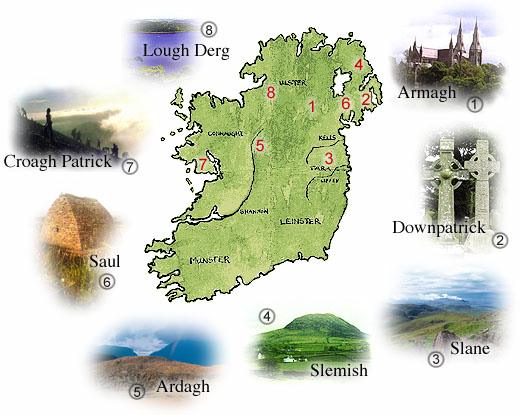
Map of Key Places in Saint Patrick’s Life (http://www.irelandseye.com/paddy/saint_pat.html)
Sources
https://www.britannica.com/biography/Saint-Patrick
https://christianhistoryinstitute.org/magazine/article/patrick-the-saint
https://www.christianitytoday.com/history/2008/august/real-st-patrick.html
 Earnest Worship
You must be logged in to post a comment.