
A few years ago, as part of my Masters work, I interviewed my Dad, David. Forgive me for using this space for personal nostalgia, but since that time, my Dad has been diagnosed with Alzheimer’s and we have lost much of him. I treasure the words and advice he gave to me that day in this interview. I am posting it here as an encouragement to others that I, too, can look back on in the future.
As a minister and son, I have always looked at the example my father set in ministry, especially as a leader. Growing up, others in our congregation have always characterized him as passionate and caring. While these characteristics did not always play out in the best light at home, as a leader, my father, David, is an excellent example of a pastor and mentor.
Dad attended the University of Mobile as a History major. He never intended to become a full-time minister, although he served part-time while getting his degree. This led to a call to ministry. In 1995, David felt the call to leave his position as Minister of Music at Hillwood Baptist Church in Huntsville to plant a church in an obscure section of Huntsville. He met with his pastor and staff and informed them of this idea, seeking prayer and council. The summer of 1996, Dad left Hillwood to plant Farley Community Church. Many thought this was an odd decision and location, as Farley Community was not the most desirable place to serve. However, through the past 15 years, God has shown His plan for Dad and Farley Community Church by changing many lives and families.
For the sake of the interview, I divided the 16 questions up into 3 categories- ministry development, church and staff relations and the theology of ministry. The first category, ministry development deals with the personal and professional development of Dad’s ministry. The second category, church and staff relations, deals with the roles, personalities, and delegation that comes with ministry. The third category, the theology of ministry, deals with David’s views on ministry and serving in a church.
Ministry Development
1. Who were leadership examples for you?
I had many leadership models and some were excellent. Quite possibly I learned as much from the poor examples as the good examples. My Dad, JR, was the biggest influence in my life. Not only was he a godly father, he was also the Minister of Music and Education in all the churches I attended as I was growing up. I watched him work with choirs and deal with the disappointments that came as members of the church failed to carry out the tasks they had accepted to do. I watched as he encouraged the youth and young adults, and I was influenced heavily by the respect he showed the senior adults and the elected leadership in the church, even when they were in disagreement and even when they were disagreeable. Other examples that heavily influenced me were: Mr. Westbrook, my band teacher, who, although I was a lousy player, treated me with respect and gave me proper discipline when it was needed; Rev. Al Finch who was my pastor during high school; and (second only to my Father) my Mother who encouraged me to read.
2. How did you first realize you were a leader?
At the age of seventeen, I was called as the Interim Minister of Music at the Riverside Baptist Church in Mobile, Alabama, which, at the time, averaged over three hundred in attendance. I learned how to lead a choir when over half of those choir members were three times my age. Leadership of the choir was more than selecting music and working to make it suitable for a worship service. I had to learn how to deal with egos, opinions, personalities, and I found out that I liked doing it.
3. Characterize your leadership style in three terms.
Consensus (building unity); flexibility; consistency
4. How has your vision of ministry changed over the course of your ministry?
For the first thirty years in the local church, I was a staff member who served as support for my Pastor. I learned how to be positive about a direction and how to emphasize strong points even when I did not totally agree with that direction or method. Every Pastor and staff member with whom I’ve had the privilege to work has contributed either positively or negatively to how I now lead as the Senior Pastor. I don’t really see a tremendous change in how I see ministry now versus how I had thirty years ago. I have always been a “people person” seeking to develop relationships with the lost in order to lead them to Christ and developing relationships with those who are saved to lead them to spiritual maturity.
Dad was heavily influenced by members of his family and church in developing of his own personal ministry. Not so many are blessed to be raised in a godly home and in church like Dad was (and I was). This was instrumental in the development of his personal talents, leadership style and ministry aspirations.
Mid-career, Dad chose to change titles and positions from Minister of Education to Pastor/Church Planter. With this transition came new tasks and responsibilities. However, his past ministry, as a part of a ministry team, became useful when required to lead others in vision and ministry.
Church and Staff Relations
1. As a leader, how do you deal with conflict in your congregation?
I will not compromise on principles or on Biblical truth, but I don’t feel that my opinion is necessarily the best on every issue, nor do I feel I should get my way every time. If someone is upset with a situation or me, I will sit down with him or her, hear him or her out, seeking reconciliation and healing. If an issue is divisive, then I will take a demonstrative stand without concern for how that stand will affect me. I am more concerned with healing, reconciliation, and redemption than with how I am affected. If it does not compromise principles or Biblical truth or does not damage the ongoing ministries of the church, I seek common ground.
2. What role does delegation of responsibility play in your ministry?
We have clearly defined roles, in writing, for each one of our ministerial and administrative staff. When issues arrive that are not covered in these written role descriptions, we meet together for clarification. We have a chart that clearly shows who is responsible to whom. Our church is staff-led and committee-driven with ultimate authority resting with the congregation in areas of disagreement.
3. How do you instill your vision for ministry in your staff?
This is a weakness, at least in the implementation of the process of accountability. I am highly motivated, and I do become frustrated when individual staff members do not share my passion, whether that be to win the lost, minister to the needy, or disciple Christians. I’m not much on setting numerical goals, but I do want my staff to be passionate about their calling.
4. How do you effectively train your staff to lead?
Again, this is an area of great weakness for me. I seek to present a good example of stewardship of time, but I have never established any ongoing training for our staff. This probably leads to a rebellion against accountability that plagues us.
5. How do you relate to other leaders and ministers in your community?
I do not have much contact with any ministers in this Association, nor do I spend a great effort in cultivating relationships outside this church. Instead I maintain contact with those outside our church whom I feel need salvation, or those being cultivated for leadership within the local body. I have participated actively with an interdenominational Concert of Prayer that meets bi-monthly in our city. That gathering has been encouraging, and praying together with pastors across denominational lines has strengthened me immensely.
Through these answers, we can see that Dad is passionate about his calling and ministry. However, he has a weakness in passing that vision and passion on to those on his staff. It is important for every ministry team member to know their role and responsibilities, but also to understand why and how these roles were created and are to be fulfilled. Dad admitting this is an area of struggle is interesting to me, as I am fully aware of what his vision for ministry is. He has instilled that vision in me and I am working in my own congregation and family with the same vision, to be out in the community, loving the lost and hurting of the world.
It is also important for Dad, as with other ministry team members and leaders, to be held accountable. Dad admitted that this was an area that “plagued” his ministry. Without accountability, a ministry cannot be maintained through trust and good relations. This is an area that, through my own personal studying, I have been working on with my own ministry team, personal and professional accountability. Not out of fear of moral or otherwise failure, but out of personal and professional growth. In this, my staff and myself, stay above reproach.
The Theology of Ministry
1. As a leader, how do you determine God’s will for your ministry?
I assume we all get caught up in the day-to-day grind and often lose sight of direction or goals. We can all become bogged down and sacrifice what needs to be done for what must be done. Sermons must be written, Bible studies prepared, newsletters and mail outs, ministry needs and witnessing to the lost. Soon the task is overwhelming. There are some tasks that must be done: crises counseling, committee meetings, and worship preparations, family time. Soon the personal time for prayer, personal study, and exercise suffers. How all this fits together must be in keeping with God’s will for the ministry to which He has called me. Is it God’s will that I met with the three young adult men for fellowship and devotion early this morning when I could have been spending that time in prayer and study? What about lunch today with the two ninth grade students who are lost? Will that allow me the time necessary for follow-up with the unmarried couple living together that was here for Bible study last week? Sometimes it is an insurmountable task to differentiate between what is God’s will for each day. Directing a staff and a church to accomplish His will is so much a greater task.
2. What role does holiness play in your leadership style?
My personal Bible study for the last two weeks has been from James 4:1-10. Pursuing holiness is an everyday growing relationship: putting off that which encumbers and putting on that which frees us. Within the confines of a crowded schedule, it is a necessary work to “Draw near to God. . .” I cannot function without a constant infilling of His Spirit. This is also a good place to mention the necessity of “rest” (physical and spiritual).
3. What role does servant hood play in your leadership style?
Does my staff see me as the leader who directs from an unapproachable office or do I experience ministry with them in visits to the hospitals and retirement homes, benevolence ministries, the seeking of the lost? If I am not a servant, how can I expect them to be servants?
4. What are some of the qualities of an effective leader?
An effective leader knows who he/she is and where they are going. An effective leader demands more of themselves than their co-workers. An effective Christian leader cares first for the One we truly serve and then serves others in humility. An effective leader leads rather than pushes, encourages rather than condemns, knows where they are going and clearly communicates that to those whom he is called to lead.
5. How do you balance ministry and your personal life?
Again, this is an area of personal struggle. As much as possible, I’ve sought to intertwine the two. My children have visited hospitals, nursing homes, senior shut-ins, and prospects with me. We worked on music together, and they helped me decide which music would work best with which choir or ensemble. As a family, we sang through cantatas before the choir saw them. Today, if I need ministerial advice, I am most likely to call my son or one of my sons-in-law who are ministers. One daughter keeps me informed on the books I need to be reading to be current with ministry styles. I do not split the sacred from the secular with my family. All of life, for us, is sacred and we share of what God is doing in and through each of us.
6. What advice would you give a young minister learning to lead?
Never expect others to do what you are unwilling to do yourself! Set goals and chart progress, not for your church’s growth but in your personal ministerial life. Who are you helping to mature in the faith? Who are you cultivating a relationship with in order to share the Gospel? Who will you share the Gospel with today, this week, this month? When was the last time you shared the Gospel, one on one, with someone who was lost and they came to know Christ as Savior OUTSIDE THE PHYSICAL WALLS OF THE CHURCH? Love your staff and be their servant! Love your people and be their servant. Never expect from your staff or congregation the work, respect, love. . .that you do not give them.
7. Where do you see your ministry in 5 years?
I pray God will open the door for me to work in a small rural church where I can be one-on-one with my people. I love my church and am blessed to be here, but I don’t want to burden this church with a slowing, ineffective administrator. The ministries here are explosive; the staff size is increasing; and the opportunities are overwhelming. This church deserves a more effective, more energetic pastor, and I need a place more in keeping with my abilities and my energy level.
Balance is important in the life of everyone, but especially leaders in ministry. Like Dad said, the difference between personal study time and ministry is often indiscernible. However, time with family and physical and spiritual rest are required for a vibrant and Spirit-led ministry.
Dad keeps with our texts in the importance he places on personal holiness and servanthood. Making time for personal devotion and prayer is vital to the maintenance of personal holiness. As Dad said, “pursuing holiness is an everyday growing relationship.” We cannot expect to grow a life of holiness without taking the time to spend in personal devotion and prayer.
If I have noticed one thing about watching my Dad minister, it is that he is a servant. Every Sunday, you can find him making coffee, setting up chairs, vacuuming, etc. He sets an example for his staff (and family) in service, and thereby inspiring them to do the same. Dad leaves us parting words about servant hood and effectiveness. Spending time outside of the church with the lost and hurting of the community is vital to the success of any ministry. Time with the lonely, outcast and downtrodden will provide the leader the means to share the gospel, cultivate relationships and set example for others on their staff and in their congregation. This is what ministry is all about, loving the lost and hurting of the world.





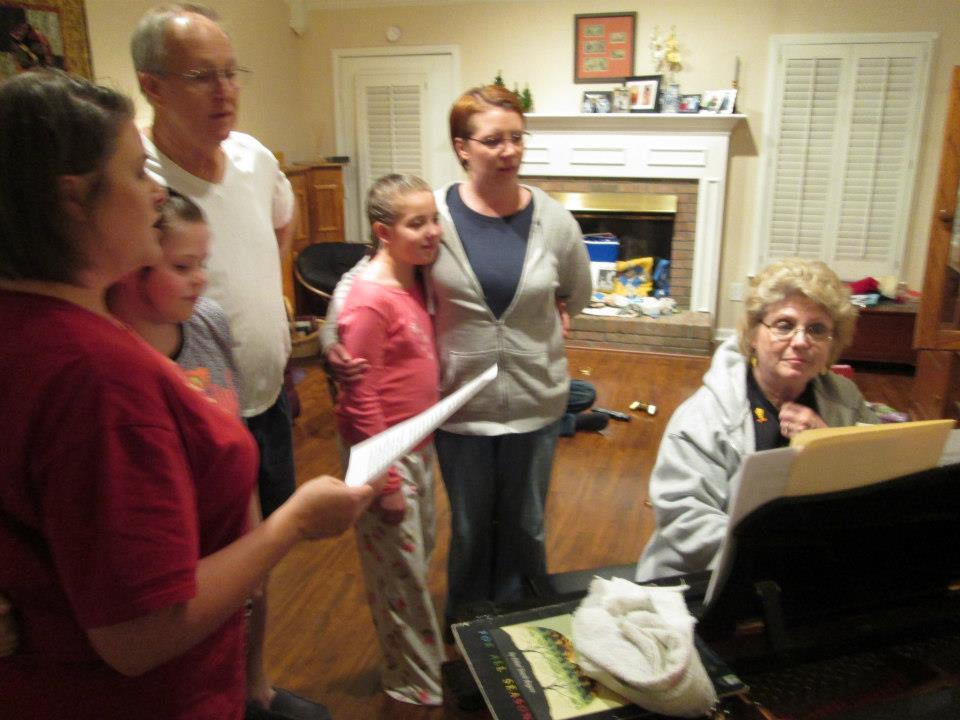

 Earnest Worship
Leave a comment